




Inflatable tent certifications are where a lot of first-time importers lose weeks. Not because the rules are impossible, but because everyone assumes there is one certificate that covers everything, and there is not. What you need depends on where you sell, who sells it, and what the product claims to do.
Why inflatable tent certifications vary by market
Camping tents are not regulated the same way in every region, and in several major markets they are not covered by a single mandatory product certificate at all. That surprises people, because buyers still demand paperwork. Retailers and marketplaces set their own entry requirements, and those are effectively mandatory if you want the listing. Meanwhile specific hazards are regulated separately: chemical content, flame behaviour, and in some cases electrical safety for any pump or light you bundle. The practical approach is to separate the legal minimum from the commercial requirement, then plan for both.
The documents buyers ask for first
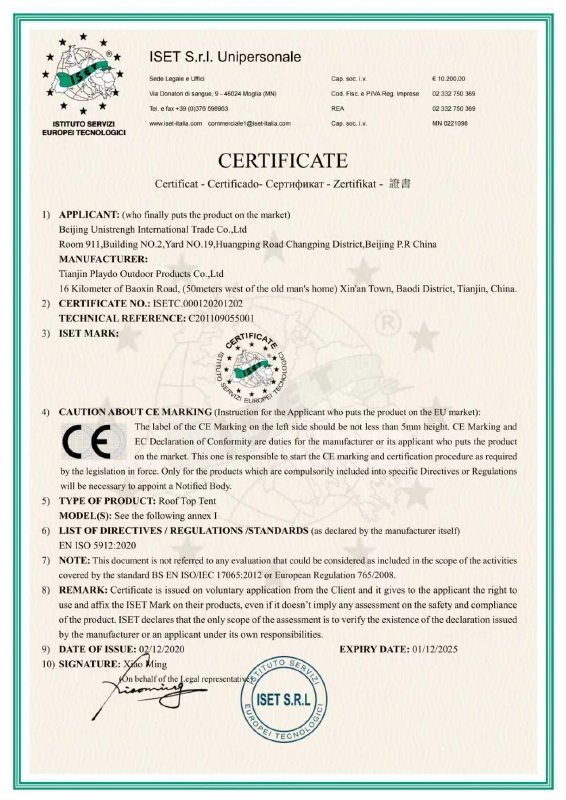
In practice, most B2B conversations start with four things. A test report for the fabric, covering things like tear strength, coating and waterproof rating from a recognised laboratory. A chemical compliance statement, which in the EU usually means REACH, and in California means Proposition 65 awareness. A flame retardancy report if the buyer’s market or venue requires it. And a declaration or technical file that ties those documents to your specific product rather than to the factory’s generic line. Buyers are not being difficult when they ask for the last one. A report on someone else’s tent tells them nothing about yours.
Flame retardancy: the rule that trips people up
This is the one that catches importers out, because requirements differ sharply by use and by region. Temporary outdoor structures, marquees and event tents are frequently held to a flame spread standard, and in the United States the tent industry commonly references CPAI-84 for camping tent fabrics. The European picture works differently, with construction-related products often classified under a system such as EN 13501-1 and consumer camping tents sitting outside that scope in most cases. Camping near a cooking flame is the real-world hazard behind all of it. Do not assume that a certificate valid for one market transfers to another, and do not assume that because a venue requires it, it is a national legal rule. Confirm both separately, in writing, with your target market’s testing body or a competent consultant.
Chemical and material compliance
REACH applies to substances in articles sold into the EU, and the practical work is knowing which substances your fabric, coating, inks and hardware contain and whether any sit on the candidate list. RoHS covers electronics, so it matters for bundled pumps, lights and cables rather than the tent itself. If you sell anything marketed to children, additional consumer product rules apply in several markets, and the age grading on the box can pull the whole product into a stricter category. Hardware is easy to overlook too: zips, buckles and coated metals can carry restricted substances even when the fabric is clean.
Structural and pressure claims
Unlike a pressure vessel, an air beam tent rarely has a mandatory structural certificate, which means your own claims become the risk. If you publish a wind rating, a snow load, or a working pressure, you should have test data behind that number, because that is exactly what a claim would examine. Keep the test method on file as well as the result, since a figure without a method is hard to defend. The same applies to capacity: a tent advertised as sleeping three should have a floor area and a mattress dimension that support it.
Who signs the paperwork and why it matters
Check whose name appears on every report. A test issued to the factory, on the factory’s product, may not be usable under your brand, and re-issuing takes time you probably do not have in the middle of a launch. Decide early whether reports go out in your name, in the factory’s name with a letter of authorisation, or both, and put that in the agreement. Ask the same question about the declaration of conformity, since someone has to be the responsible party in the market and it is usually the importer, not the manufacturer abroad. Getting inflatable tent certifications right is mostly logistics and filing. The importers who struggle are the ones who treat it as a formality and discover the gap when a retailer asks for a document nobody ordered.
FAQ: inflatable tent certifications
Is CE marking required for camping tents? In most cases camping tents fall outside mandatory CE marking, though buyers and platforms still ask for test reports. Confirm for your product and market.
What is CPAI-84? A widely referenced flame retardancy standard for camping tent fabrics in the United States. Requirements differ by region and by use.
Does REACH apply to a tent? Yes, for substances in articles placed on the EU market, covering fabric, coatings, inks and hardware.
Can I use the factory’s test reports? Sometimes, if they name your product and you have authorisation. Confirm whose name is on the document before you rely on it.
Planning an import? Review the products in our [inflatable rooftop tent range](https://www.playdooutdoor.com/product-category/rooftop-tent/) and send your target markets to [our team](https://www.playdooutdoor.com/contact/) so we can match the right documentation.

