




A factory tour can look impressive: clean showroom, rows of finished products, staff in uniforms, and a wall full of certificates. But that does not automatically tell you how the factory will handle your order.
For rooftop tents, a useful factory audit should stay close to the actual production process. You want to see where materials arrive, how critical parts are made, how products are checked, and what happens when something does not pass.
Look past the showroom
The showroom helps you understand the range, but the production floor tells you more about workflow and consistency. Ask to see cutting, sewing, air-beam or structural assembly, finishing, inspection and packing areas.
Ask where critical parts come from
Inflatable rooftop tents depend on more than outer fabric. Air columns, valves, seams, mattresses and attachment points all matter. Ask which parts are produced in-house and which come from outside suppliers.
Check how quality is recorded
“We inspect everything” is not very specific. Ask what the inspection includes, what is tested during production, what is checked before packing, and what happens when a defect is found.
For inflatable products, air retention or pressure checks should have a defined method. PlayDo’s Starry Sky 2 page, for example, states that the model undergoes a 24-hour inflation test before packing. That kind of concrete information is much more useful than a generic quality statement.
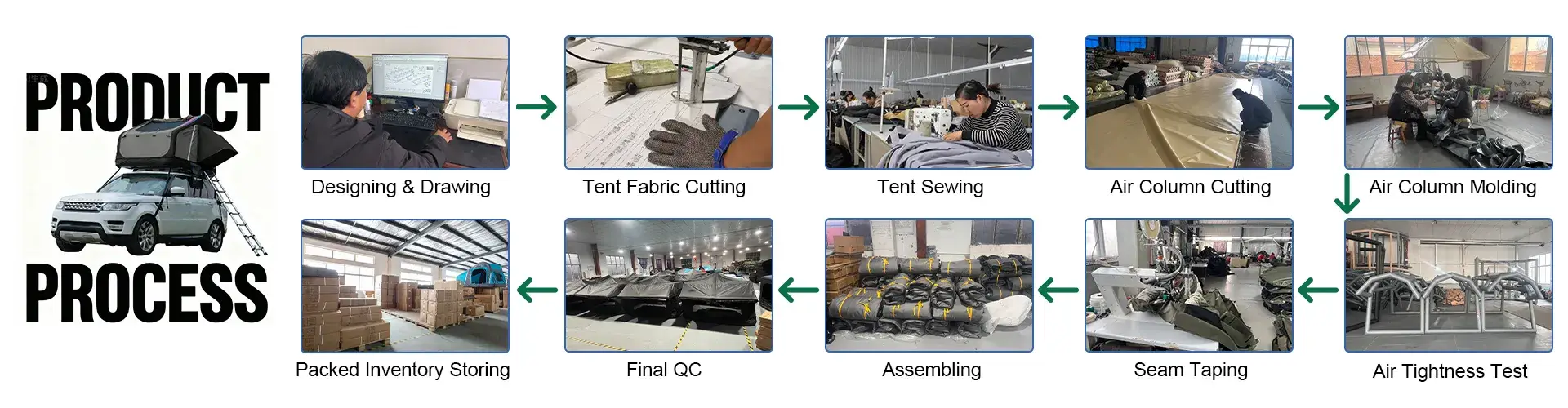
Ask who handles product development
If you are buying a standard product, R&D may not be your first concern. If you want OEM or ODM work, it matters much more. Ask whether there is a real product-development team and whether the factory can discuss design changes, materials and prototypes.
See the packing area
Packing is often where attention to detail becomes visible. Look at how accessories are counted, how cartons are identified, and how finished products are stored before loading.
Ask about realistic capacity
Instead of focusing on the biggest production number a factory can quote, ask about normal output for your product category, the number of production lines in use, and what happens during peak periods.
Check communication before you need help
A factory audit is also a test of communication. Ask who will handle technical questions, artwork approval, production updates and after-sales issues. A clear contact structure matters once the order is running.
What you should have after the audit
By the end of the review, you should understand four things: the factory’s product capability, its production process, its quality-control checkpoints and its ability to support your project after shipment.
PlayDo currently presents itself as a manufacturer with in-house production and OEM/ODM services across rooftop tents and outdoor equipment. For a buyer, the useful factory audit is therefore the one tied to the exact product category and project requirements, not a generic tour.
FAQ
Q: Do I need to visit the factory in person? A: Not always. A third-party inspection or detailed remote factory review can also provide useful information, depending on order size and risk.
Q: What should I ask to see first? A: Production flow, quality checkpoints, material handling and the area where your type of product is assembled and packed.
Q: Is a large factory always better? A: Size alone does not tell you whether a supplier fits your product, order volume or customization needs.

