


Every strap on a rooftop tent has a boring job until the day it does not: it holds the tent closed on the highway, it hangs the ladder, it ties the package down. That is why rooftop tent strap strength deserves numbers instead of adjectives, and in August 2026 we went to SGS to get them, pull-testing both the strap and the finished buckle assembly. The results, 4600 N and 1660 N, tell a story every B2B buyer should understand, because the gap between those two numbers is where product quality actually lives.
What went into the machine
We sent two sample types to the SGS lab in Tianjin, report number TJMR260800561001:
- Sample A: the PlayDo-branded jacquard webbing used across our tents
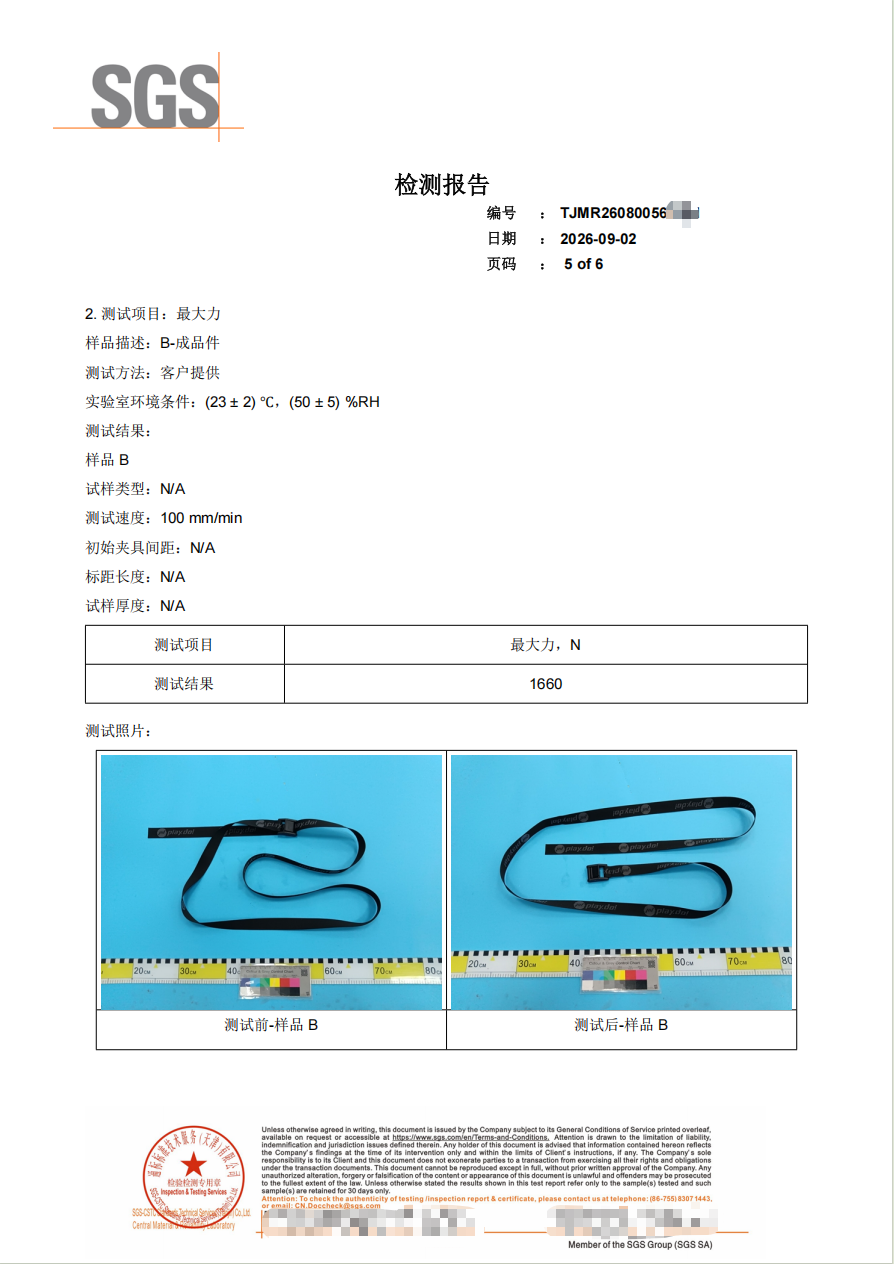
- Sample B: a finished buckle assembly, the plastic hardware as it is actually stitched and pressed onto the strap
Testing ran in a conditioned lab at 23 ± 2 °C and 50 ± 5 % relative humidity, on a universal testing machine, pulling at 100 mm per minute. If you have never watched a tensile test: the clamps grip the sample, the crosshead rises slowly, the load curve climbs, and eventually something gives. The whole pull takes under a minute. Deciding what to test is the part that takes experience.
The rooftop tent strap strength results
Sample A, the webbing itself, broke at 4600 N. That is roughly the hanging weight of a 470 kg load. Sample B, the finished buckle assembly, reached 1660 N, around 170 kg.
Two numbers, and the interesting one is the second.
If we had only tested the webbing, we would have walked away saying “our straps are good for nearly half a tonne”. But nobody buys loose webbing. You buy a strap with a buckle on it, and the buckle joint, where strap meets hardware, is where strength leaks. Heat pressing and stitching always cost something relative to the virgin webbing. Testing the finished assembly is the only way to know how much.
Why the weaker number is the honest one
In engineering terms, your tie-down system is a chain: webbing, stitching, buckle, D-ring, roof bar. The chain holds only as much as its weakest link. A 4600 N webbing paired with a 1660 N buckle gives a system rating of 1660 N, and pretending otherwise would be the kind of spec-sheet optimism that eventually injures someone.
So why not just spec a stronger buckle? Because 1660 N is already well above what a rooftop tent tie-down ever sees in service, and over-specing hardware adds weight and cost without adding real safety. The engineering job is matching the numbers deliberately, not maximising one of them.
One more thing we want every buyer to internalise: breaking strength is not working load. Standards bodies apply safety factors (often 4:1 or more for lifting hardware) to turn break strength into a safe working load. We publish test values so you can verify quality, not as a licence to hang four hundred kilos off a strap.
What we do with these numbers
Internally, this report now anchors our incoming inspection. When a new batch of webbing or buckles arrives, the question is whether it matches the qualified samples, and now “qualified” has a number attached. For B2B buyers, it means the straps on the tents you order are a specified component with test evidence behind them, not an anonymous part that swaps with the cheapest quote.
It also changed one small thing in our packing process: the straps that ship tensioned in the carry bag now get checked against the batch report, because a strap that spends months compressed is the one most worth re-verifying.
FAQ: rooftop tent strap strength
What did the webbing and buckle test results show?
SGS tensile tests, report TJMR260800561001: webbing broke at 4600 N, finished buckle assembly at 1660 N, pulled at 100 mm/min in a conditioned lab.
Why is the buckle weaker than the webbing?
The buckle joint introduces stitching and heat-press points that cost strength relative to continuous webbing. The finished assembly is the honest system number, and it is the one that governs.
Is 1660 N enough for a rooftop tent?
For tie-down and ladder duty, yes, with large margin. It is not a vehicle roof load rating; roof load is governed by your vehicle and rack, which are separate systems.
Can I get the test report?
Yes, contact us and we will share it. We also encourage buyers to run their own verification on incoming goods.
This is one part of our quality system; see how a full shipment gets checked in our [factory QC overview](https://www.playdooutdoor.com/inflatable-tent-factory-qc/), and if you are sourcing tents for a brand, our [OEM vs ODM guide](https://www.playdooutdoor.com/oem-vs-odm-inflatable-tent/) explains where components like webbing sit in the customisation process.
Reviewed by the PlayDo Outdoor product team, October 2026.