


Written by Bill · Reviewed by the PlayDo Outdoor product team
An ISO certified tent factory answers three separate questions: ISO 9001 proves the quality system, ISO 14001 proves the environmental management, and ISO 45001 proves worker health and safety. Together they tell a buyer that this is a structured, audited operation rather than a workshop running on memory.
Key takeaways
- ISO 9001 covers quality, ISO 14001 covers the environment, ISO 45001 covers worker safety.
- Certification means an outside auditor checked the system, not just a sample.
- Every certificate has a number and a scope you can verify online.
- Ask for the certificate number and scope, then look it up.
What each ISO standard actually covers
ISO is a family of standards, and the three a buyer should know are the management-system ones.
ISO 9001 is quality management. It means the factory has a written system for how it designs, produces, inspects, and fixes mistakes, and that an auditor confirmed it works. It does not mean every unit is perfect. It means there is a process, and that process gets checked.
ISO 14001 is environmental management. It covers how the factory handles waste, energy, and materials, and whether it has a plan to keep improving. For buyers selling into Europe, this matters more every year.
ISO 45001 is occupational health and safety. It covers how the factory keeps the people on the line safe, from machine guarding to protective gear to incident records.
A factory that holds all three is saying its quality, its footprint, and its workforce are all under documented control.
Why an ISO certified tent factory matters when you source tents
Sourcing a tent from overseas is mostly about managing risk, and risk is exactly what a management-system certificate reduces.
A workshop can make a good first sample by luck. What it cannot do by luck is repeat that sample across a thousand units, track a defect back to its cause, and fix it so the next batch is better. That is a system, and it is what ISO 9001 audits.
The same logic applies to the other two. A buyer who sells to retailers or into the EU is often asked about the factory’s environmental and labor practices. Holding ISO 14001 and ISO 45001 means you have an answer that is already backed by third-party audits, which saves you from having to prove it yourself later.
How to verify a certificate is real
The thing about ISO is that it is easy to fake a logo and easy to check a number.
Every legitimate ISO certificate carries a certificate number and the scope it was issued for. In China, management-system certificates are also registered with the certification authority, CNCA, so a number can be traced to the issuing body and the covered company.
The scope is the part buyers skip, and it is the part that matters. A certificate that covers “tent production and outdoor goods sales” is different from one that covers something unrelated. Read the scope, check the company name matches, then verify the number.
Our three certifications, and what they cover
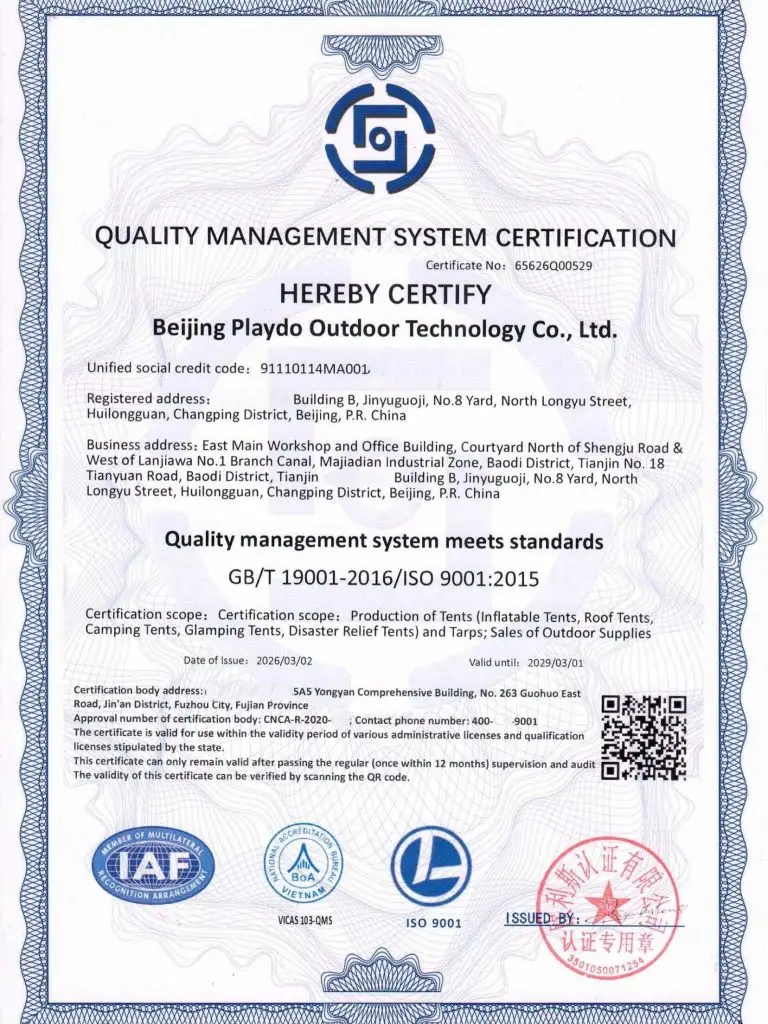
We hold all three, and they are current, valid into 2029, issued for our own Tianjin factory where we have been building tents for over eleven years. Our ISO 9001:2015 certificate carries number 65626Q00529R010, with ISO 14001:2015 and ISO 45001 each holding their own certificate number.
Our ISO 9001:2015 certificate covers the design and production of tents, including inflatable tents, rooftop tents, camping tents, hotel tents, and relief tents, plus canopies, along with the sale of outdoor goods. Our ISO 14001:2015 certificate covers the same production scope, so the environmental side is audited against the exact work we do. Our ISO 45001 certificate covers the occupational health and safety system for that same production.
The point is that the scope lines up with the product. When a buyer asks us to back up a quality claim, we point to the certificate number and the scope, not to a logo on a footer. If you are weighing suppliers and want to see how a certified factory handles your [inflatable rooftop tent](https://www.playdooutdoor.com/product-category/rooftop-tent/inflatable-rooftop-tent/) order, our team can share the certificates and walk you through the system behind them.
FAQ: ISO certified tent factory
What does ISO 9001 prove?
That the factory runs a documented quality system covering design, production, inspection, and corrective action, and that an outside auditor verified it.
Are ISO 9001, 14001 and 45001 the same thing?
No. They cover quality, environment, and worker safety in that order. A well-run factory often holds all three, but each is a separate audit.
How do I check an ISO certificate is real?
Read the certificate number and the scope, confirm the company name, then trace the number to the issuing body. In China, certificates are registered with CNCA.
Does ISO certification guarantee product quality?
It guarantees a system, not perfection. It sharply reduces the risk of random defects and non-repeating problems, which is what most buyers actually need.
ISO certificates are a fast way to sort structured factories from workshops, and the numbers are free to check. When you are ready to compare suppliers, ask each one for the certificate number and scope before you ask for a price. To see how our certified setup handles a real order, browse our [inflatable rooftop tent range](https://www.playdooutdoor.com/product-category/rooftop-tent/inflatable-rooftop-tent/) or [message our team](https://www.playdooutdoor.com/contact/) and we will share the certificates and answer your sourcing questions.