An inflatable rooftop tent is a car-mounted shelter that uses pressurized air beams — instead of rigid metal poles or a heavy hard shell — to hold its structure. You mount it on your vehicle’s roof rack, and with a single pump it inflates into a full, standing tent in just a few minutes. It has quickly become one of the fastest-growing categories in the overlanding and car-camping world, and for good reason.
If you’ve been researching rooftop tents and keep running into the words “inflatable,” “air pole,” or “air beam,” this guide explains exactly what they mean, how the technology works, and whether an inflatable rooftop tent is right for you.

How Does an Inflatable Rooftop Tent Work?
Instead of aluminum or steel poles, an inflatable rooftop tent is built around air beams — sealed tubes made of a tough inner bladder wrapped in a durable outer sleeve. When you connect a hand or electric pump and inflate the beams to a set pressure, they become rigid enough to support the entire tent structure, including the walls and roof.
The setup process is simple:
- Open the tent cover and unfold the tent body.
- Connect the pump to the single inflation valve.
- Inflate the air beams to the recommended pressure.
- Extend the ladder and secure the tent.
The whole process typically takes 5 to 7 minutes, and packing down is just as fast — you open a valve, the air releases, and the tent folds back into its travel cover.
Because there are no loose poles to assemble, lose, or bend, the experience is far more beginner-friendly than a traditional pole tent, and there’s nothing rigid to damage your vehicle or injure a family member during setup.
Inflatable vs. Traditional Rooftop Tents: What’s the Difference?
| Feature | Inflatable Rooftop Tent | Pole Rooftop Tent | Hard-Shell Rooftop Tent |
| Setup time | 5–7 min (pump) | 10–15 min (assemble poles) | 30 sec–2 min |
| Weight | Light (often under 30 kg) | Medium | Heavy (often 60–90 kg) |
| Packed height | Low, soft-pack | Medium | Bulky hard case |
| Poles to break | None | Many | None |
| Price | Mid-range value | Entry-level | Premium |
| Wind flexibility | Beams flex, then rebound | Poles can bend/snap | Very rigid |
Inflatable models hit a sweet spot: much faster and lighter than pole tents, and far more affordable and packable than hard shells. The air beams also flex in strong gusts and spring back into shape, rather than bending permanently like a metal pole.
Key Benefits of an Inflatable Rooftop Tent
Fast, tool-free setup. One pump replaces a dozen poles. This is the single biggest reason campers switch.
Lightweight and fuel-friendly. Lower weight on your roof means less strain on your rack and better fuel economy than a heavy hard-shell unit.
Safer for families. No rigid poles to swing around or pinch fingers, and no sharp metal ends. The soft, flexible structure is more forgiving.
Durable in wind. Quality air beams are designed to flex under load and recover, which helps them handle gusts that might bend rigid poles.
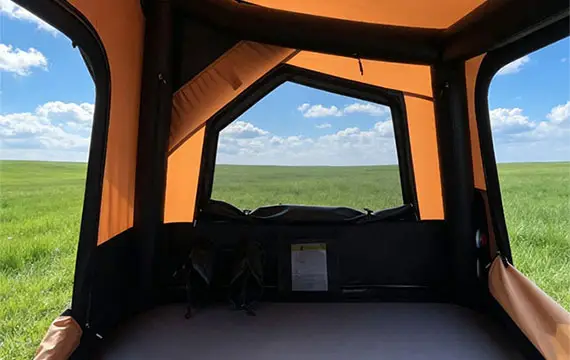
Comfortable, standing-height interior. Air-beam geometry allows for tall, roomy interiors with near-vertical walls, giving you more usable space than many pole designs.
Who Is an Inflatable Rooftop Tent For?
- Overlanders and road-tripperswho set up and tear down camp frequently and want to save time at every stop.
- Familieswho value a safe, quick, hassle-free setup.
- Weekend camperswho want rooftop comfort without the high cost and weight of a hard shell.
- Rental fleets and glamping operatorsthat need durable, easy-to-operate shelters for guests.
If you rarely move camp and prioritize the absolute fastest setup regardless of price, a hard shell may suit you. For nearly everyone else, an inflatable model offers the best balance of speed, weight, comfort, and value.
How to Choose the Right Inflatable Rooftop Tent
Check the air-beam pressure system. Look for a unified low-pressure design (around 6–7 PSI) that inflates all beams evenly through one valve — it’s simpler and more reliable than juggling multiple high-pressure tubes.
Verify the materials. The outer tent should use waterproof, UV-resistant fabric (such as heavy-denier polyester or poly-cotton canvas), and the air beams should have a strong TPU bladder inside a protective sleeve.
Match the size to your crew. Two-person and family (3–4 person) sizes are the most common. Confirm the mattress dimensions, not just the marketing “capacity.”
Confirm vehicle compatibility. Check your roof rack’s dynamic load rating and the tent’s mounting requirements before buying.
Buy from an experienced manufacturer. A factory with real R&D and patents behind its air-beam design will deliver better sealing, durability, and after-sales support.
As a specialized rooftop tent manufacturer with 11+ years of experience and 100+ patents, [PlayDo Outdoor](https://www.playdooutdoor.com/) designs inflatable rooftop tents around a patented unified low-pressure air-beam system, exporting to 120+ countries with full OEM/ODM support. You can explore the full [inflatable rooftop tent range here](https://www.playdooutdoor.com/product-category/rooftop-tent/).
Frequently Asked Questions
Q: Are inflatable rooftop tents safe and durable?
Yes. Quality air beams use a tough TPU bladder inside an abrasion-resistant sleeve and are engineered to hold pressure for the life of the tent. The flexible structure actually handles wind gusts better than rigid poles, which can bend or snap.
Q: How long does an inflatable rooftop tent take to set up?
Most inflate in 5–7 minutes with a hand or electric pump — significantly faster than assembling a traditional pole tent.
Q: Do inflatable rooftop tents leak air overnight?
A well-made tent with quality valves holds pressure through the night. Minor pressure changes from temperature shifts are normal and don’t affect stability; a quick top-up in the morning (if ever needed) takes seconds.
Q: What happens if an air beam gets punctured?
The tough outer sleeve protects the inner bladder from most hazards. In the rare event of a puncture, beams are repairable with a patch kit, and reputable manufacturers supply spares.
Q: How much does an inflatable rooftop tent weigh?
Many two-person models weigh under 30 kg, making them lighter than most hard-shell tents and easier on your roof rack and fuel economy.
Q: Can I use an inflatable rooftop tent in winter?
Yes. Look for 4-season models with insulated, waterproof fabric. The sealed air-beam structure has no cold metal poles and holds heat well.