




A rooftop tent electric pump turns a five minute arm workout into a two minute job where you stand around holding a hose. That is most of why people buy one. The part that gets missed is that a pump designed for airbeds and paddle boards can push far more pressure than an air beam wants, and pressure is what actually damages a tent.
Why a rooftop tent electric pump beats a hand pump on most trips
Speed is the obvious gain, but consistency is the real one. A hand pump leaves you guessing, and a beam that is slightly soft at bedtime is a beam that looks worse at 3 am when the temperature drops. An electric pump with an auto shut-off hits the same pressure every time, which means your setup is repeatable and you stop second guessing it. The trade-off is that you now own a thing with a battery or a cigarette plug, and both can fail, so a hand pump stays in the bag as backup.
Pressure: what the numbers on the dial mean
Most inflatable rooftop tent beams work somewhere between 4 and 7 psi, which is about 0.28 to 0.48 bar. That is low. A paddle board often runs near 12 to 15 psi, and an inflatable boat can go higher still, so a pump built for those will happily overshoot a tent beam if you let it. Over-inflating is worse than under-inflating, because excess pressure loads the seams and the welded joints rather than the fabric. Check the label on your tent, set the pump’s cut-off to that number, and treat the printed figure as the ceiling rather than a target to exceed.

Speed and duty cycle: the spec nobody checks
Advertised fill times assume a small volume and a cold pump, so take them loosely. What matters more is duty cycle, which is how long the pump can run before it needs to rest. A cheap high pressure unit may manage five minutes before it gets hot and slows down, which is fine for one beam and frustrating for four. Look for a pump with a low pressure, high volume mode, sometimes called a deflate or inflate mode, rather than a single high pressure setting. Low pressure pumps move a lot more air per minute at the pressure a tent needs, so they finish faster even though their maximum psi is lower.
Power sources for a rooftop tent electric pump
Three options, with different failure modes. A 12 V pump running from the vehicle socket is the simplest and will not run flat, though a typical socket is fused around 10 to 15 amps, so check the pump’s draw before you plug it in. A battery powered pump is the most convenient and the one people forget to charge, so build charging into your pack-down routine rather than your departure morning. A mains unit is fine at home and useless at a trailhead. If you camp far from the vehicle, battery wins. If you camp next to it and want zero maintenance, 12 V wins.
Hoses, valves and adapters
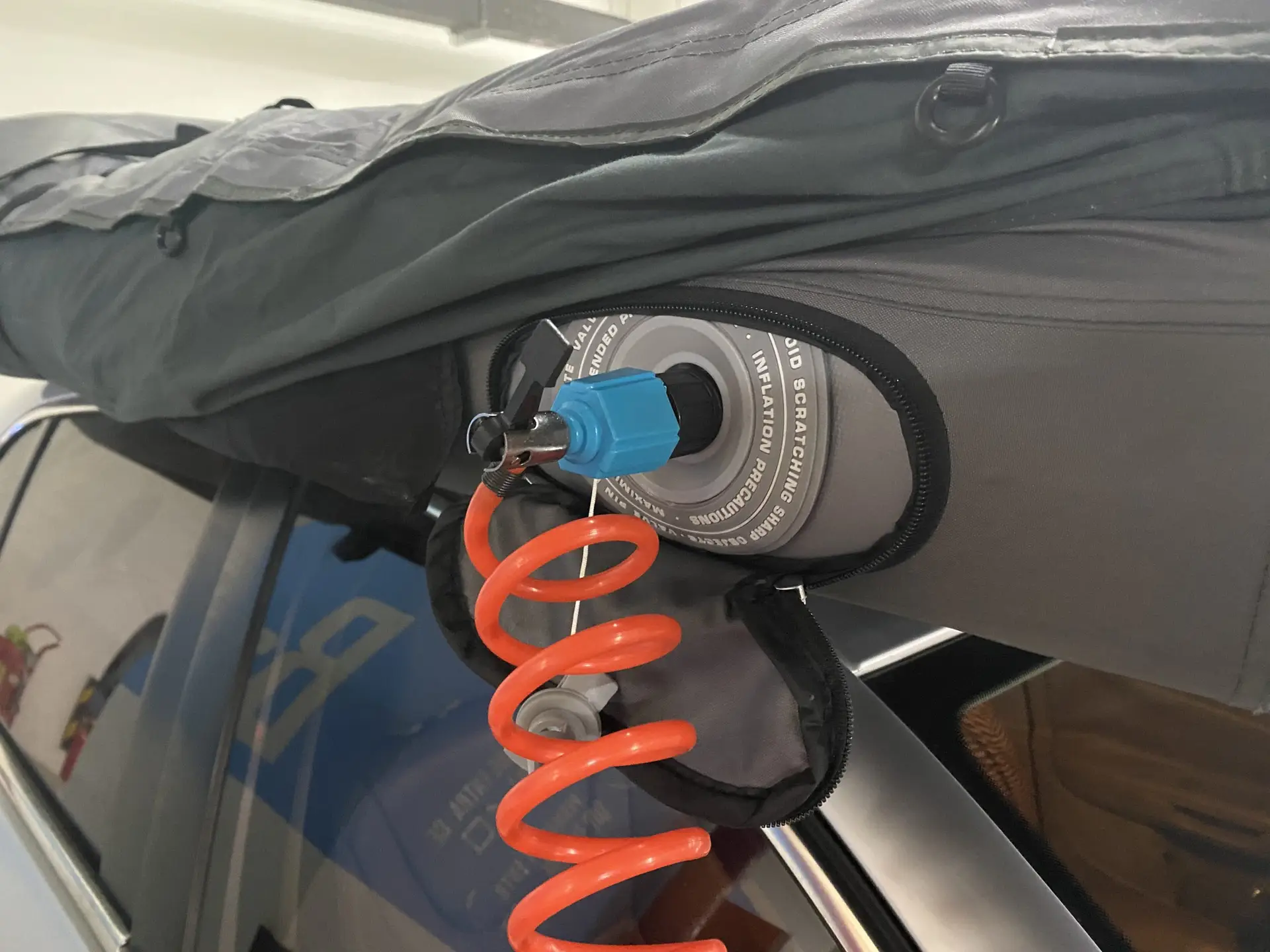
Half the frustration with any pump is the connection, not the motor. Match the valve type before you buy, since tent valves vary between makers and a pump that fits one brand may need an adapter for another. Use a hose long enough to reach the valve without lifting the pump, because holding a vibrating pump against a hot vehicle gets old fast. Keep a spare valve core and a small spanner in the kit. A leaking valve core looks exactly like a slow puncture in the beam, and people have deflated a perfectly good tent looking for a hole that was never there.
Care and what to carry
Let the pump cool before it goes into a closed bag, keep sand out of the intake, and store the hose loosely coiled rather than folded tight. Once or twice a season, check the cut-off by inflating a beam and comparing the pump’s reading with a separate gauge, because a drifted gauge is how quietly over-inflated tents happen. Keep the hand pump, one spare valve core, and the adapter set together in a single pouch. A rooftop tent electric pump is a comfort item, so the moment it becomes the only way to pitch your tent is the moment it becomes a liability.
FAQ: rooftop tent electric pump
What pressure does a rooftop tent need? Commonly 4 to 7 psi, around 0.28 to 0.48 bar. Use the figure printed on your tent rather than a generic number.
Can I use a paddle board pump? Sometimes with an adapter, but check the cut-off. Those pumps reach pressures well above what a tent beam wants.
Is a 12 V or battery pump better? Battery suits camps away from the vehicle. 12 V suits anything within hose reach and never goes flat, but check the socket’s amp limit.
Why does my pump stop before the beam is firm? Duty cycle. Give it a few minutes to cool, then resume, and check the cut-off setting is not set too low.
Get the pressure right and the tent lasts longer. Browse our [inflatable rooftop tents](https://www.playdooutdoor.com/product-category/rooftop-tent/) for model-specific ratings, or ask [our team](https://www.playdooutdoor.com/contact/) about valve types.



